

Football positions explained in plain language: what the goalkeeper, defenders, midfielders and forwards do, the shirt numbers linked to each role and common formations.
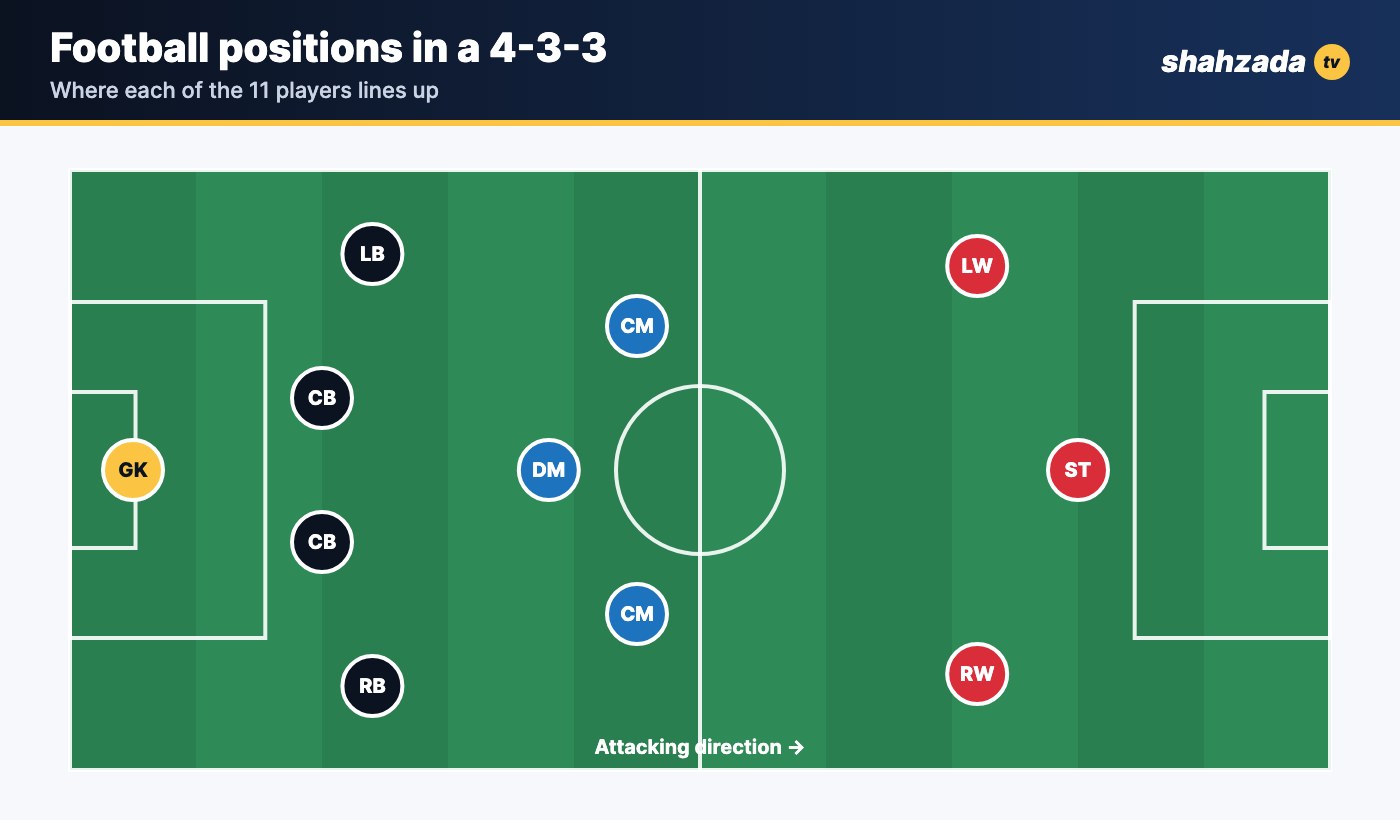
Football positions tell each of the 11 players where to stand and what job to do. Every team has one goalkeeper and ten outfield players, and those ten are split into defenders, midfielders and forwards. This guide explains all the football positions, the shirt numbers traditionally linked to them and how they fit into a formation.
Football positions at a glance
| Position | Short | Traditional number | Main job |
|---|---|---|---|
| Goalkeeper | GK | 1 | Stops shots and organises the defence |
| Right-back | RB | 2 | Defends the right side and supports attacks |
| Left-back | LB | 3 | Defends the left side and supports attacks |
| Centre-back | CB | 4 and 5 | Marks strikers and wins headers and tackles |
| Defensive midfielder | DM | 6 | Protects the defence and starts moves |
| Central midfielder | CM | 8 | Links defence and attack |
| Attacking midfielder | AM | 10 | Creates chances behind the striker |
| Right winger | RW | 7 | Attacks down the right side |
| Left winger | LW | 11 | Attacks down the left side |
| Striker | ST | 9 | Finishes chances and scores goals |
Numbers are a tradition, not a rule. Today players can wear almost any number, but coaches and commentators still say “a number 9” or “a number 10” to describe a role.
The four lines of football positions
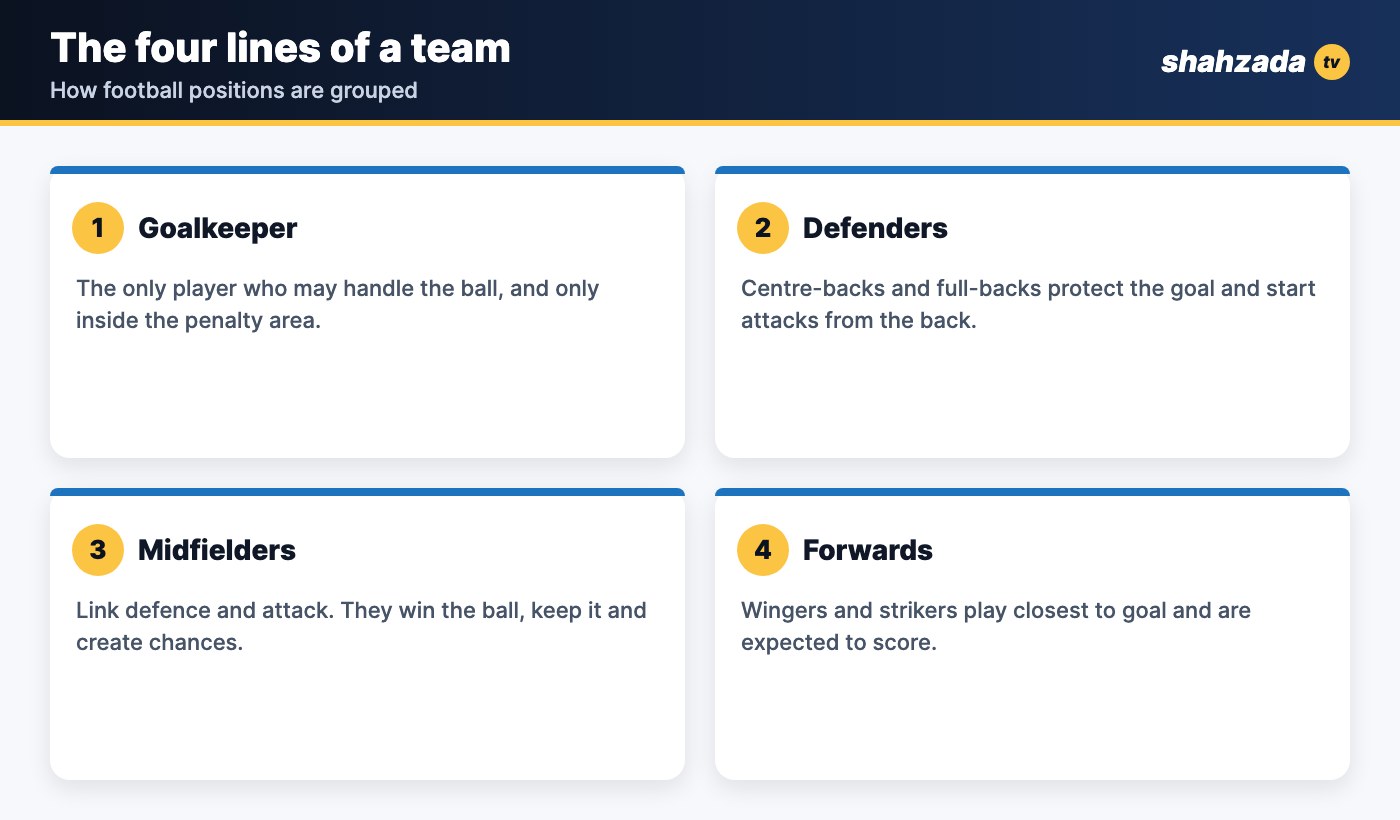
The easiest way to learn football positions is to think of four lines from the back of the pitch to the front.
Goalkeeper
The goalkeeper is the only player allowed to handle the ball, and only inside their own penalty area. Modern goalkeepers also pass the ball out to start attacks.
Defenders
Centre-backs play in the middle of the defence. Their job is to mark the striker, win headers and block shots. Full-backs play on the left and right. They defend against wingers and run forward to help the attack.
Midfielders
Midfielders cover the most ground. A defensive midfielder sits in front of the defence and breaks up attacks. A central midfielder moves between both penalty areas. An attacking midfielder plays close to the striker and looks for the final pass.
Forwards
Wingers play wide and use speed to beat defenders. The striker plays closest to the opponents’ goal and is usually the team’s main goalscorer.
How football positions fit into formations
A formation is written as numbers from defence to attack, without the goalkeeper. A 4-3-3 means four defenders, three midfielders and three forwards.
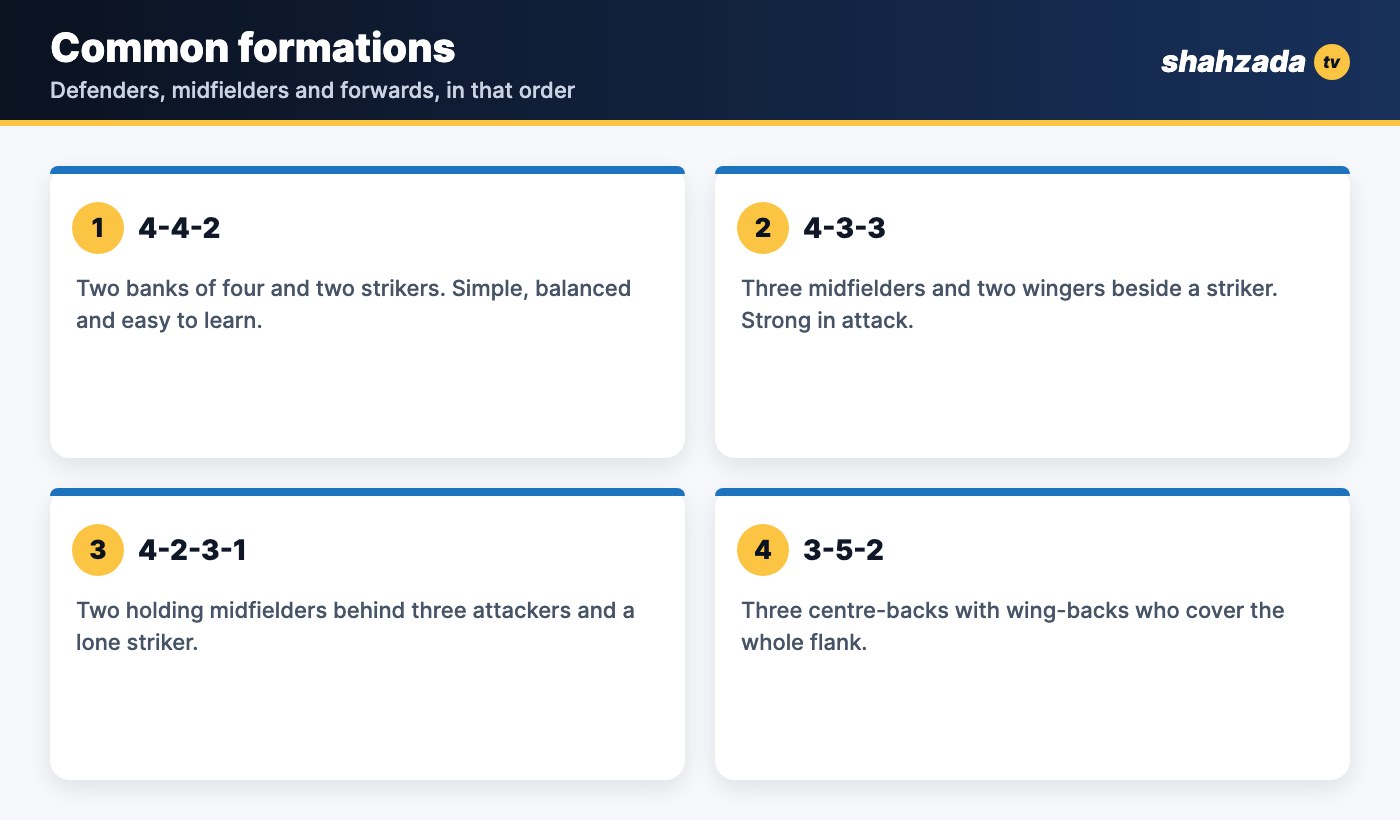
The formation changes how many players fill each line, but the basic jobs stay the same.
Which position should a beginner play?
- Fast and good at dribbling: winger or full-back.
- Tall and strong in the air: centre-back or striker.
- Good passer who reads the game: central midfielder.
- Brave with quick reactions: goalkeeper.
Young players should try several football positions before choosing one, because each role teaches a different part of the game.
Frequently asked questions
How many football positions are there?
There are 11 players on the pitch, grouped into four types: goalkeeper, defenders, midfielders and forwards.
What is a number 10 in football?
A number 10 is an attacking midfielder who plays between the midfield and the striker and creates chances.
What is the hardest position in football?
It depends on the player. Goalkeeper and central midfielder are often called the most demanding because of the pressure and the amount of decision-making.
Related
Read our simple guide to the offside rule, see who is the most popular footballer, or browse all football stories.
Source
Player numbers and the role of the goalkeeper are covered in the Laws of the Game published by The IFAB.