

Volleyball rules for beginners: how many players, how scoring and sets work, the three-touch rule, rotation, the most common faults and the court size.
Volleyball rules are easy to learn once you know the basics: six players a side, three touches to return the ball, and a point on every rally. This beginner’s guide covers the volleyball rules you need to follow a match or play your first game.
Volleyball rules at a glance
| Rule | What it says |
|---|---|
| Players on court | 6 per team |
| Touches allowed | 3 per team before the ball crosses the net |
| Scoring | A point is scored on every rally |
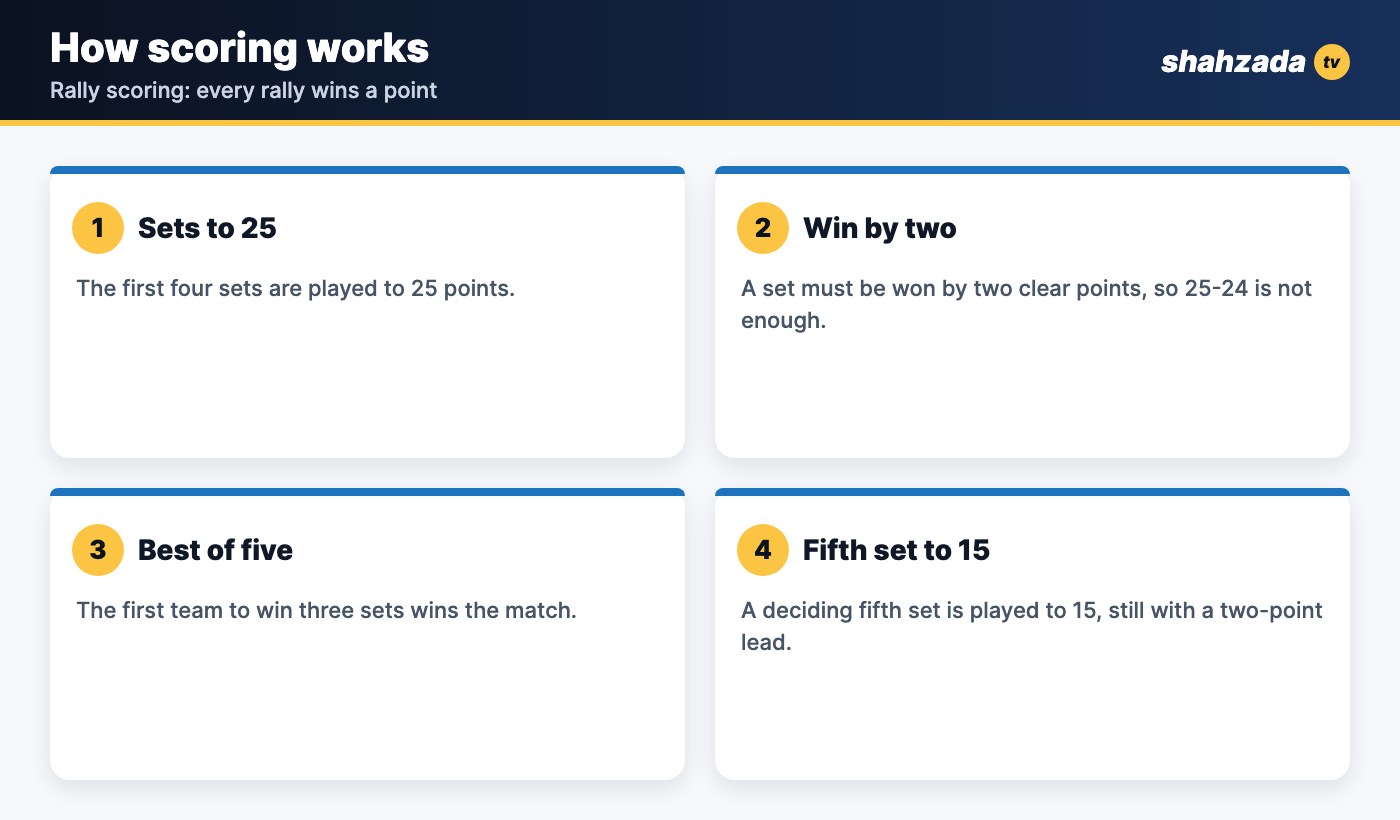
| Sets | To 25 points, win by 2 |
| Match | Best of 5 sets, fifth set to 15 |
| Court size | 18 m long and 9 m wide |
| Net height | 2.43 m for men, 2.24 m for women |
How a rally works
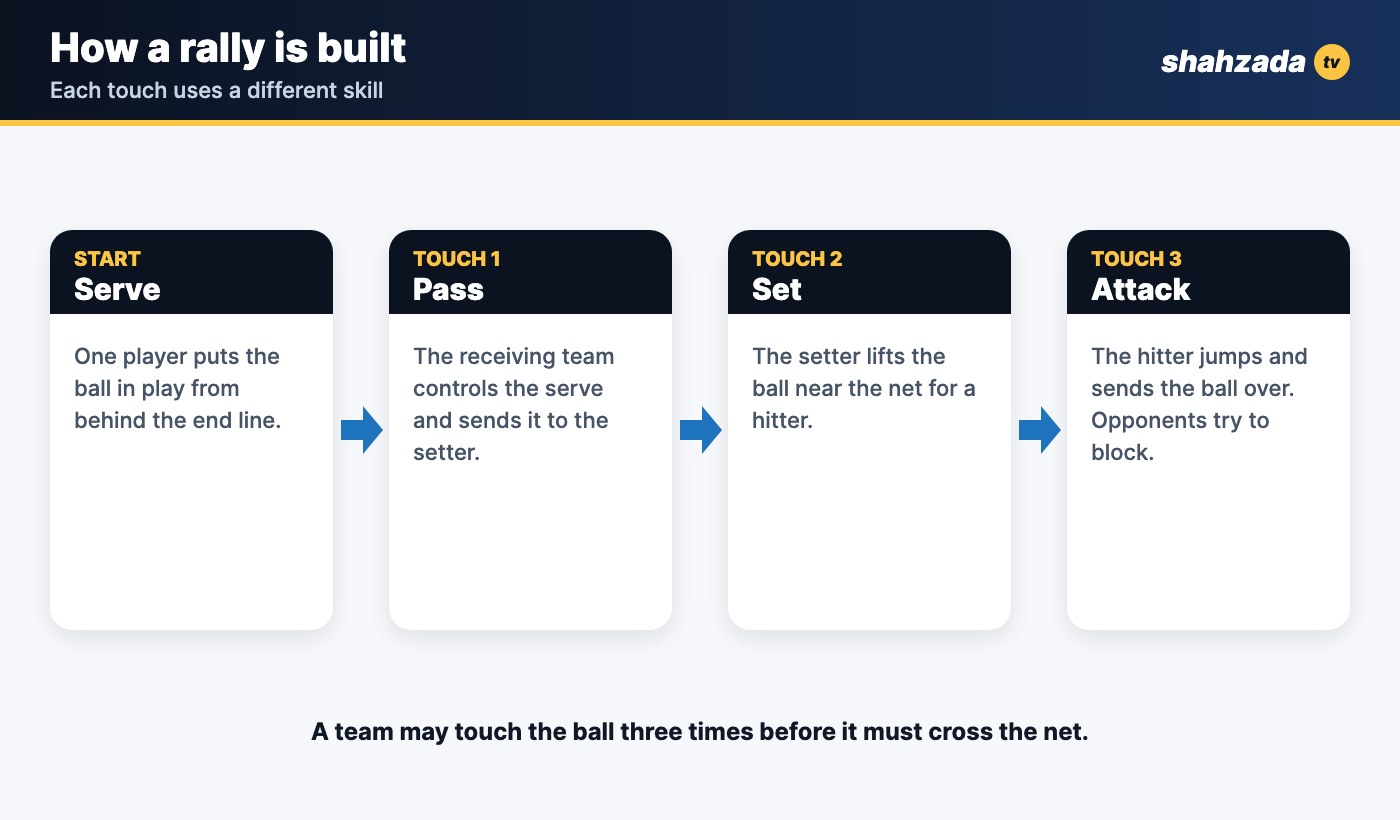
A rally starts with a serve from behind the end line. The receiving team has up to three touches to send the ball back over the net, usually a pass, a set and an attack. The rally ends when the ball hits the floor, goes out, or a team commits a fault.
Volleyball rules on scoring
Volleyball uses rally scoring. Whichever team wins the rally gets a point, whether it served or not. The team that wins the rally also serves next.
The three-touch rule
A team may touch the ball a maximum of three times. The same player cannot touch it twice in a row. A block does not count as one of the three touches, so a team can still pass, set and attack after its block touches the ball.
Rotation
When the receiving team wins a rally, its players rotate one position clockwise and a new player serves. Players must be in the right order when the ball is served. Our guide to volleyball positions shows the six positions and how rotation works.
Common faults in volleyball rules
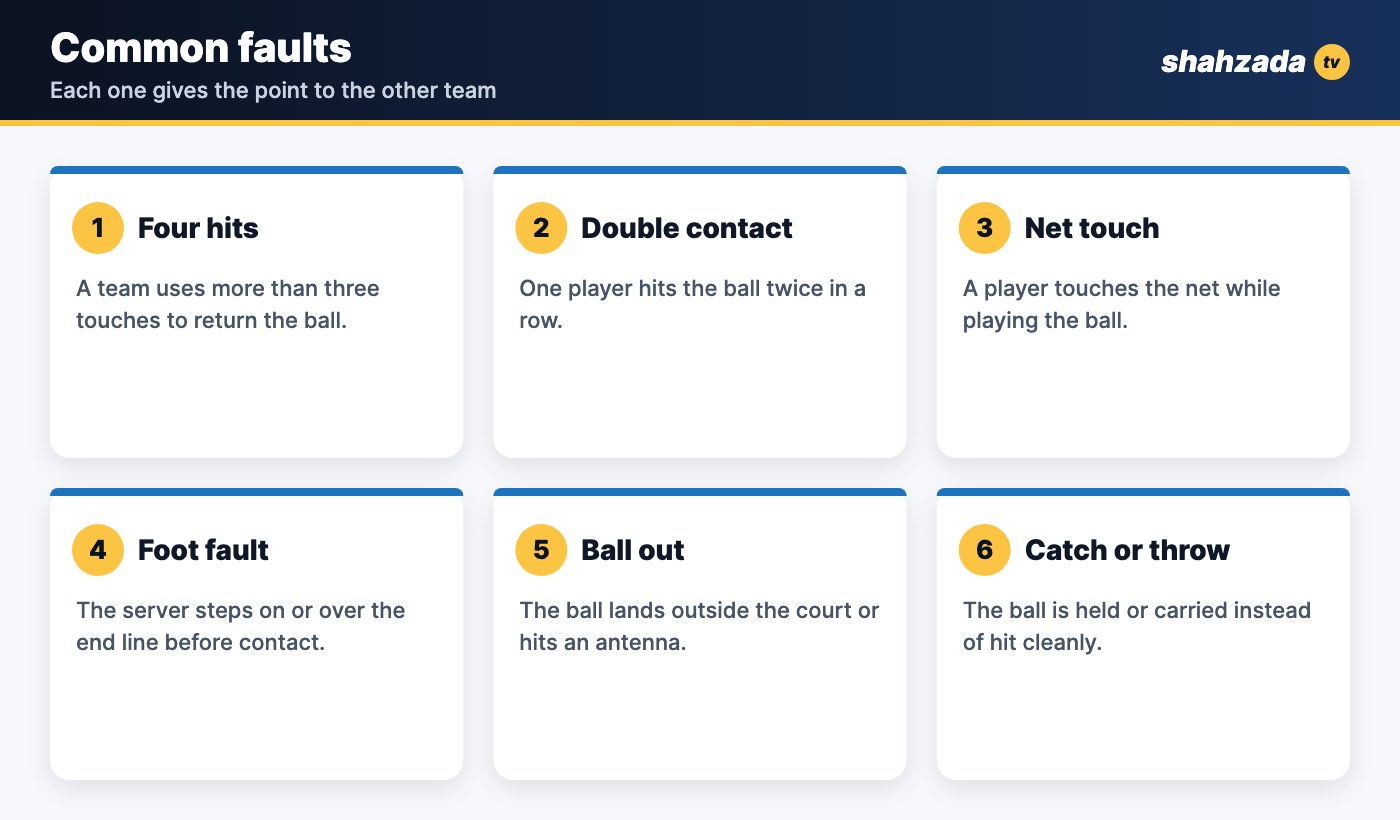
A fault ends the rally and gives the point to the other team. These are the ones beginners make most often.
Serving rules
- The server stands behind the end line and must not step on it before hitting the ball.
- The server has 8 seconds to serve after the referee’s whistle.
- The ball may touch the net on a serve, as long as it goes over.
The libero
The libero is a back-row defender who wears a different colour shirt. Under FIVB volleyball rules the libero cannot serve, block or attack the ball above the height of the net.
Frequently asked questions
How many points do you need to win a set?
25 points, with a lead of at least two. A deciding fifth set is played to 15.
Can the ball hit the net?
Yes. The ball can touch the net during a rally or a serve and stay in play if it crosses to the other side.
Can you use your feet in volleyball?
Yes. The ball may be played with any part of the body, although hands and forearms are used most.
Related
Next, learn the five core volleyball skills, or browse all volleyball stories.
Source
These volleyball rules follow the official rules of the FIVB, volleyball’s world governing body.