

Volleyball positions explained: what the setter, outside hitter, opposite, middle blocker and libero do, the six court positions and how rotation works.
Volleyball positions can confuse new players because the word means two different things. It can mean the role a player has, such as setter or libero, and it can mean the numbered spot on the court where a player stands. This guide explains both kinds of volleyball positions and how rotation connects them.
Volleyball positions by role
| Role | Main job | Usually plays |
|---|---|---|
| Setter | Sets the ball for the hitters | Right side |
| Outside hitter | Main attacker and serve receiver | Left side |
| Opposite hitter | Attacks and blocks on the right | Right side |
| Middle blocker | Leads the block, hits quick sets | Centre of the net |
| Libero | Passes and digs in the back row | Back row only |
| Defensive specialist | Strengthens back-row defence | Back row |
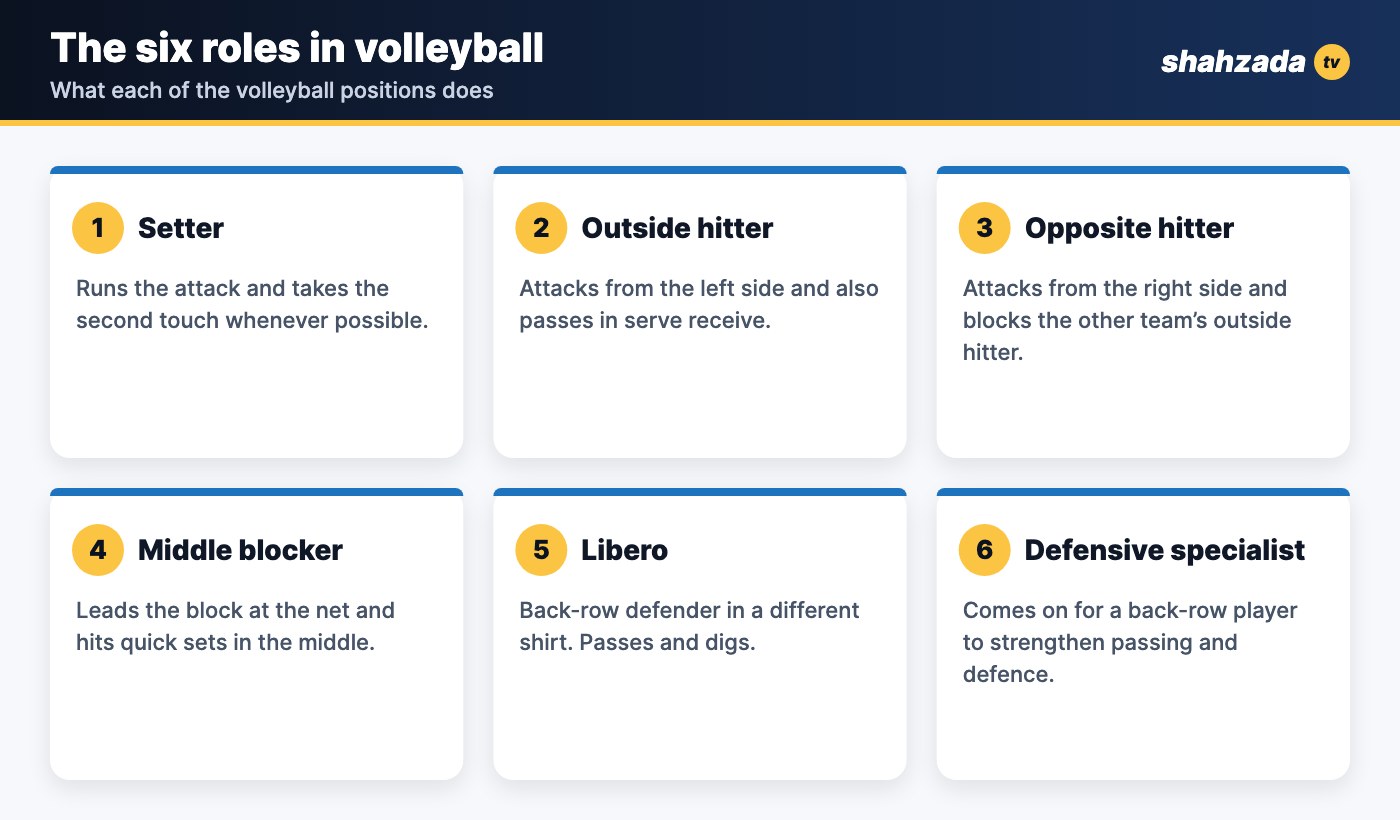
Setter
The setter decides who attacks. They try to take the second touch of every rally and place the ball where a hitter can score.
Outside hitter
The outside hitter attacks from the left front and is also a key passer when the other team serves. Most teams give this player the most sets.
Opposite hitter
The opposite plays across from the setter. They attack from the right side and block the other team’s outside hitter.
Middle blocker
Middle blockers are usually the tallest players. They try to block every attack and hit fast sets close to the setter.
Libero
The libero wears a different colour shirt and plays only in the back row. Under FIVB rules the libero cannot serve, block or attack the ball above the height of the net.
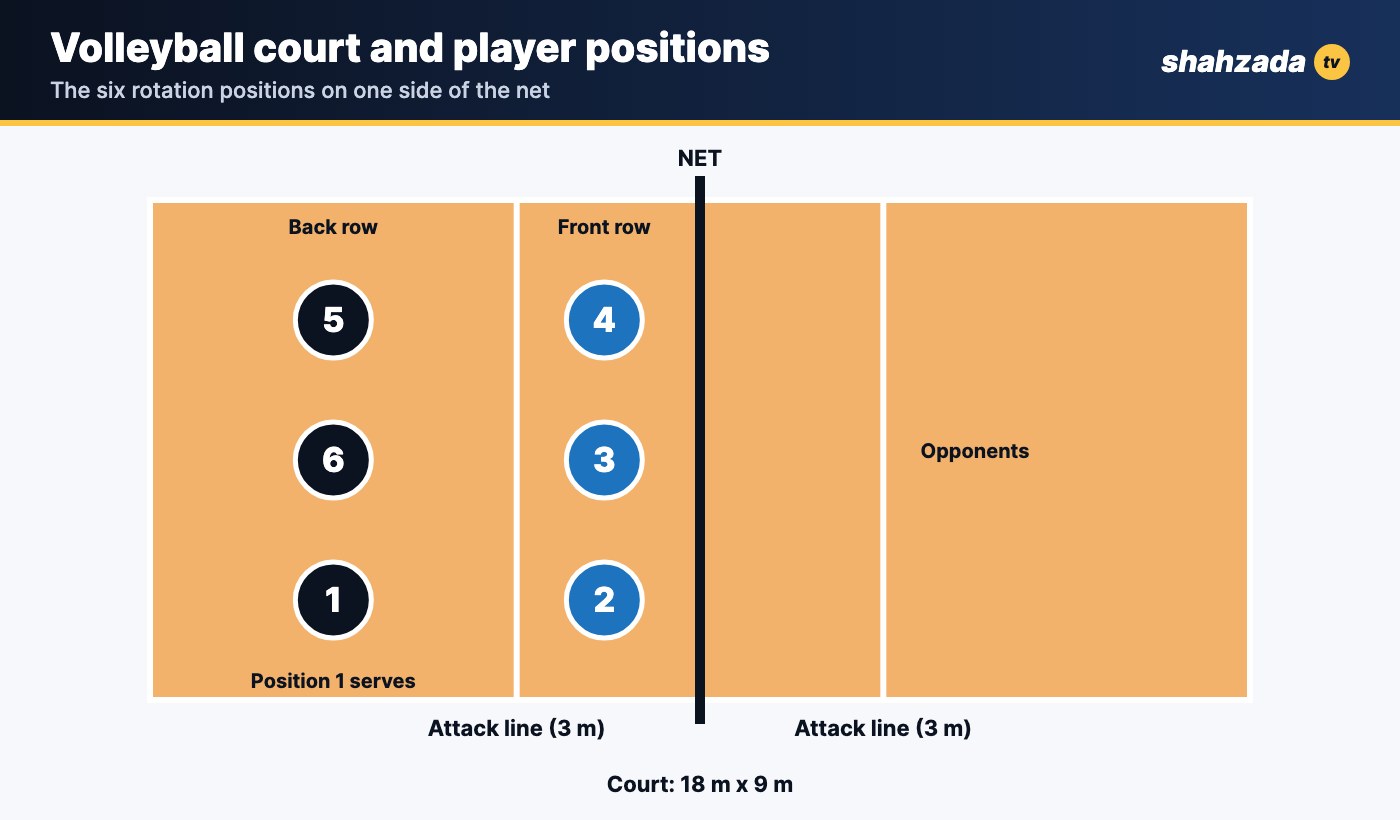
Volleyball positions on the court: 1 to 6
Each side of the court has six numbered positions. Positions 2, 3 and 4 are the front row, next to the net. Positions 1, 6 and 5 are the back row. The player in position 1 is the server.
How rotation changes volleyball positions
When the receiving team wins a rally, it earns the serve and all six players rotate one place clockwise. This means every player passes through all six court positions during a set, including the front row and the back row.
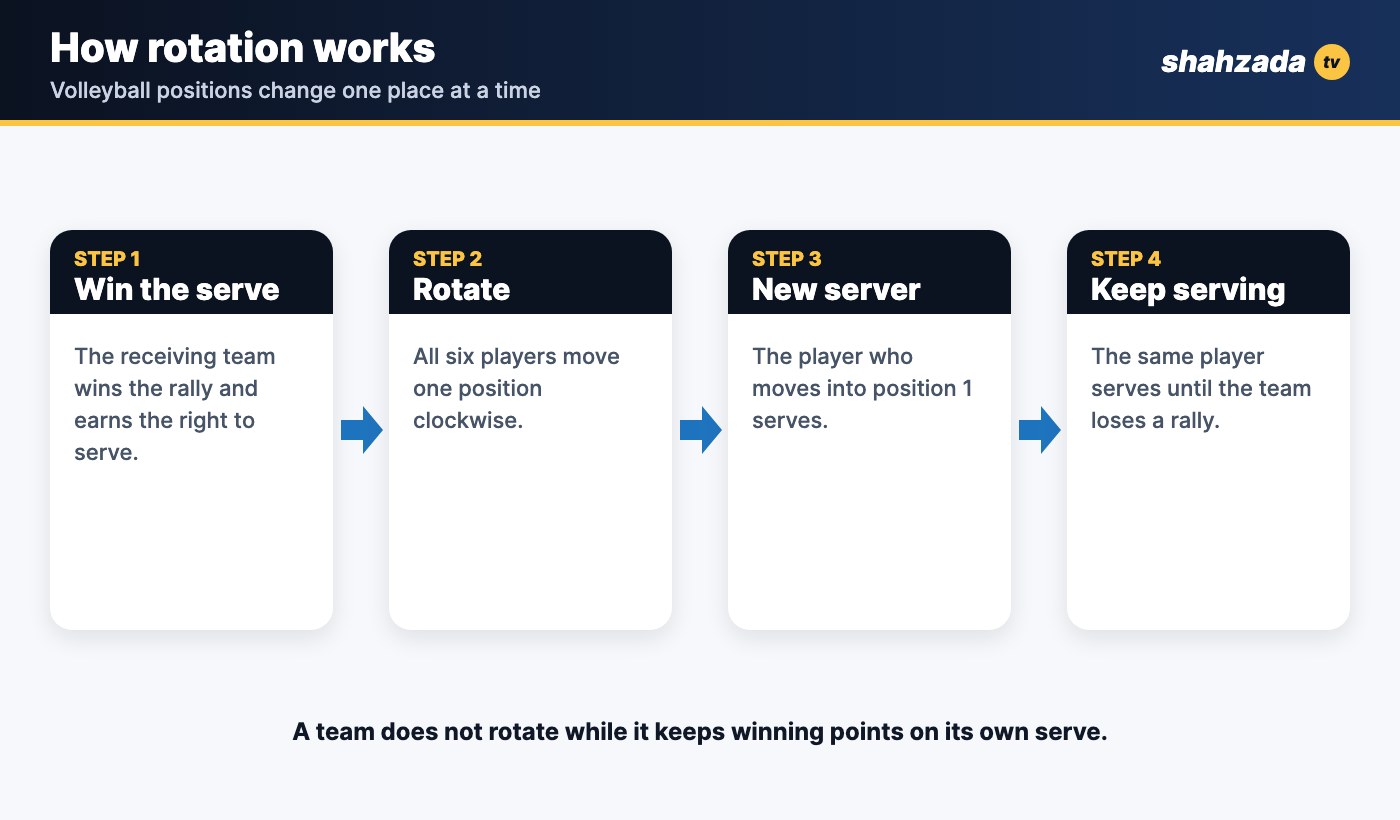
Players must be in the correct rotation order when the ball is served. After the serve they can move, which is why the setter often runs to the right front straight away.
Which position suits you?
- Good hands and quick decisions: setter.
- Strong jump and all-round skills: outside hitter.
- Tall with fast reactions at the net: middle blocker.
- Quick, low and reliable at passing: libero.
Frequently asked questions
How many volleyball positions are there?
There are six court positions, numbered 1 to 6, and five main roles: setter, outside hitter, opposite hitter, middle blocker and libero.
Why does the libero wear a different shirt?
So the referees can easily see which player is the libero and apply the special rules for that role.
Which way do teams rotate?
Clockwise, one position at a time, each time the team wins back the serve.
Related
Learn the five skills every volleyball player should master, read our volleyball rules for beginners, or browse all volleyball stories.
Source
Rotation and libero rules are set out in the official rules of the FIVB, volleyball’s world governing body.